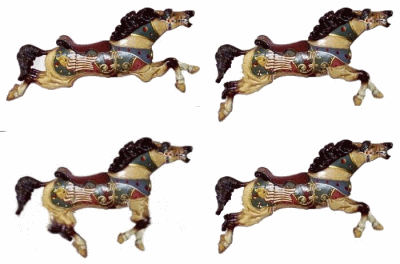
Lead ("King") horse: Usually the outside row horse directly behind the chariots. These horses are usually the largest and fanciest on the ride. Newer fiberglass carousels may have lead horses intermingled with the other animals.
Jumper: Also called "gallopers". Usually has all four feet off the ground. The horses that move up and down are generally "jumpers".
Stander: At least 3 feet on the ground. Lead or "King" horses are usually standers. Hey, if you're the "king", you don't have to jump or gallop for anyone!
Brass ring: On older carousels, you could grab the brass ring to win a free ride. Now in this politically-correct, sue-happy age, the brass rings are mostly gone. Additionally, the brass rings (or wood or plastic later on) would find their way into trash heaps, be flung to break windows, etc., so insurance became a factor in their demise even before political-correctness took hold.
Romance side: the side of the horse that faces the public. Usually the most decorative though today some carvers will decorate both sides.
Chariots: Also called lover's seats, these are the benches for us old folks who can't get on the horses and would rather snuggle and smooch!
Band organ: the music apparatus. This is NOT a calliope. Usually works with music rolls or books, although modern band organs can also work with computer files. There is no greater music than a very LOUD band organ!
The direction of the carousel: American carousels usually run in a counterclockwise direction to facilitate grabbing the brass ring (which is now mostly gone) with the right hand. English carousels usually ran clockwise. This apparently was to enable the rider to mount his horse "properly" from the left side.
Menagerie: any animal that is not a horse. These can include cats, zebras, lions, tigers (and bears, oh my!), hippocampuses, elephants, rabbits, deer, elk, pandas, giraffes, ostriches, roosters, camels, dogs, pigs, goats, donkeys, mules, literally any animal, real or mythical, that the carver could dream up! My favorite non-horse animal is the Dentzel cat. Dentzel carousels often had these whimsical cats, usually with a fish, bird or some other cat-fascinator in its mouth, obviously running to find a place to hide and enjoy its treat. Today's carvers creating new carousels will often create an animal or mythical creature that has special significance to the area in which the carousel is to operate, giving that carousel an aura of specialness to the community that is hard to overlook.
Manufacturers/Carvers: Most of the old carvers didn't sign their work. Some horses had manufacturer's marks built into the design of the animal, such as PTC for Philadelphia Toboggan Company. Some names you'll hear when learning about carousel animals are Stein and Goldstein, Philadelphia Toboggan Company, Marcus Illions, C. W. Parker, Gustav & William Dentzel, Charles Looff, Daniel C. Muller, Charles Carmel, Charles W. Dare, Herschell/Spillman and Allan Herschell. My favorites are usually Stein/Goldstein and Marcus Illions horses, who usually are big and strong, have expressive eyes, flaring nostrils and seem ready to charge! C. W. Parker horses are often recognized first by carousel novices, as they often populated the older "country fair" carousels that travel around the country at festivals and fairs. The small horse "running" at the top of this page is a beautifully restored C. W. Parker pony! Horses carved by Daniel Muller were often decorated in military gear and were astoundingly realistic.
Styles of carousels: American carousels generally come in two different styles. There is the Country Fair style, which typically is the small, portable 2-row model most of us see at the county fair. Then there is the Coney Island style which is usually a permanently installed large machine with several rows of animals, such as those installed at the famous Coney Island amusement parks of old. Both can be strikingly beautiful! Some consider the Philadelphia Toboggan Company (PTC) Carousels to be a third style on their own, but they can also fall into the other two styles.
There is a another type of ride, though few exist today. Derby rides featured almost life-size carousel-type horses mounted in slotted rows. Instead of going up and down, these horses moved swiftly around a slotted "racecourse" at up to 15mph. Some horses could even carry two riders! One of these rides is located at the Cedar Point amusement park in Sandusky, Ohio, along with two other antique carousels, making Sandusky a "must" destination for any carousel nut! If you go there, don't forget to visit the famous Muller "Ghost horse" in the park museum (Frontiertown). Although a reproduction rides the carousel now, years ago when the original "Ghost" rode it, it is said that sometimes, late at night after the park had closed, the ghostly figure of a woman would mount "Ghost" and the carousel would begin to turn by itself. Eek! For more on the famous Muller ghost horse, see the Ghosts of Ohio website.